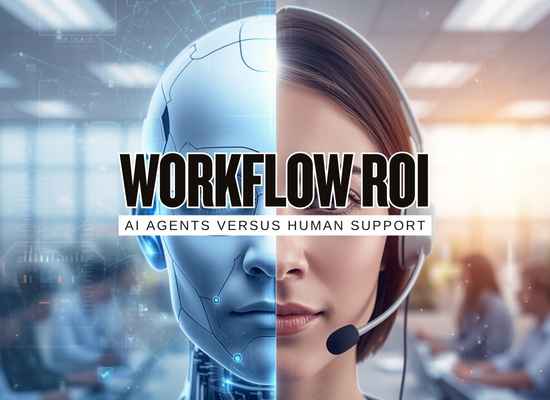
Small businesses in 2026 are hearing two very different promises. AI agents are being sold as always-on workflow engines that can automate multi-step processes, while virtual assistants are still one of the simplest ways to offload admin, coordination, follow-up, and customer support work without building complex systems. The tricky part is that both can improve productivity, but they do not create ROI in the same places. McKinsey says organizations are already experimenting with or scaling agentic AI, while QuickBooks reports that 68% of U.S. small businesses were using AI regularly in 2025 and 9% were already using agentic AI. At the same time, the U.S. Chamber says 58% of small businesses now use generative AI, but it also reports ongoing adoption barriers, which is a reminder that not every workflow is ready for agent-style automation yet.
Small Business Workflow Comparison
The wrong choice wastes money twice
First you pay for the tool or person. Then you pay again in cleanup, delays, missed follow-up, or broken customer experience if the workflow was a bad fit in the first place.
The quick verdict
AI agents usually produce better ROI when
The work is repetitive, digital, rules-based, high-volume, and annoying enough that automation compounds every week.
Virtual assistants usually produce better ROI when
The work is messy, relationship-sensitive, full of exceptions, still evolving, or needs context and judgment more than perfect consistency.
The real comparison
Most owners compare cost first. That is usually the wrong starting point. The better comparison is workflow shape, management burden, time to value, and whether the output still needs human rescue after it is done.
The three biggest ROI questions
1. Does this workflow repeat often enough to justify automation
Agents become much more attractive when the same process fires constantly. If the business is repeatedly sorting leads, routing requests, summarizing meetings, drafting updates, reconciling transactions, or pushing reminders, agent ROI can become very strong because the savings stack.
2. How much judgment and improvisation still lives inside the work
Virtual assistants win more often when the owner keeps saying things like “use your judgment,” “check the tone,” “decide which one matters most,” or “follow up differently depending on the person.” Those instructions are a clue that the workflow is not yet stable enough for full automation to deliver clean ROI.
3. Who is doing the cleanup when something goes wrong
This is the hidden question that makes or breaks ROI. If a virtual assistant needs constant re-explaining, the savings shrink fast. If an agent creates wrong routing, weak drafts, bad classifications, or customer confusion, the cleanup cost can quietly erase the benefit. The winner is the option that reduces total management drag, not just surface-level task time.
Workflow battlegrounds
Workflow
Better first bet
Why it wins
Biggest risk
Inbox triage
AI agent
Fast sorting and categorization compounds daily
Bad routing creates hidden delays
Scheduling and reminders
AI agent
Highly rules-driven and repetitive
Exception logic can get messy
Lead qualification
Hybrid
Automation handles sorting, human handles nuance
Good leads can be misread early
Bookkeeping prep
AI agent
Transaction-heavy and software-native
Exceptions still need review
Customer follow-up
Virtual assistant
Tone and context often matter more than speed
Assistant can become a bottleneck if unmanaged
Travel and calendar coordination
Virtual assistant
Tradeoffs and preferences change constantly
Too much owner clarification
Internal reporting summaries
AI agent
Recurring reports are ideal for automation
Weak source data produces weak insight
Executive admin support
Virtual assistant
Human prioritization is still very valuable
Fragmented instructions reduce ROI
The mistake patterns
When owners choose an AI agent too early
They try to automate a workflow that still changes every week, involves too many exceptions, depends on undocumented preferences, or carries too much customer sensitivity. The result looks efficient in demos but sloppy in production.
When owners choose a VA too long
They keep assigning highly repetitive digital work to a person even after the workflow is stable enough to automate. The assistant stays busy, but the business keeps paying for work that should have become a system.
A better rollout plan
Step 1
Pick one workflow that happens often, drains time, and can be clearly described.
Step 2
Write down the exact inputs, steps, decisions, exceptions, and outputs.
Step 3
If the workflow is mostly rules and repetition, test an agent. If it is mostly nuance and exceptions, test a VA.
Step 4
Measure time saved, errors avoided, response speed, owner interruptions, and customer friction. Then decide whether to expand, split, or switch.
Workflow ROI Scanner
Score one workflow in your business. Higher totals lean toward AI agents. Lower totals lean toward a virtual assistant.
Rare and variedFrequent and repeated
Mostly judgmentMostly rules and logic
Messy and manualInside software
Constant exceptionsVery few exceptions
Very sensitiveLower sensitivity
Your likely winner
0/25
AI agent
Best next move
The cleaner conclusion
If a workflow is stable, repetitive, digital, and easy to evaluate, AI agents usually offer better long-run ROI. If a workflow depends on context, changing priorities, and human nuance, virtual assistants usually offer better short-run ROI. For many small businesses, the strongest answer is not choosing one camp. It is letting automation handle the structured portion and letting a person own the unpredictable portion.